Contact centre agents become frustrated when the answer exists, but they cannot find it while a customer waits. A knowledge management system (KMS) solves this by giving every agent one trusted and current source of answers. Less searching means less stress for agents, faster resolution for customers, and a lower cost of service.
Customers are rarely the main source of agent frustration. The bigger problem is the hunt for information mid-call.
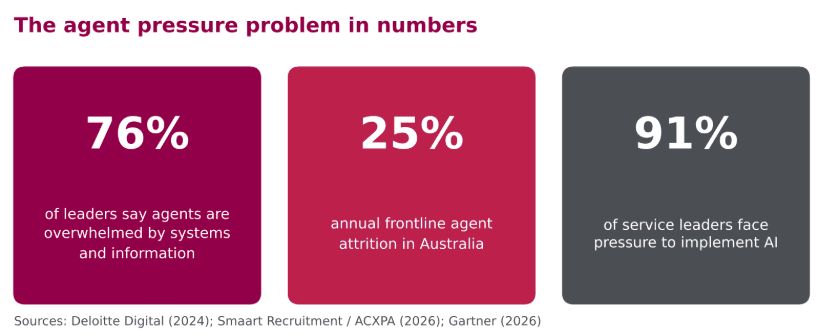
In Deloitte Digital’s 2024 Global Contact Center Survey of 600 contact centre leaders, 76% said their agents are overwhelmed by systems and information. Every slow search leaves a customer waiting and an agent under pressure, and that pressure builds across every shift.
The causes are familiar to most contact centre leaders:
A knowledge management system is software that captures, organises, governs, and delivers an organisation’s knowledge from one central source. In a contact centre, it acts as the single source of truth agents use to answer questions accurately and consistently. Unlike a shared drive or intranet, a KMS controls who writes content, who approves it, and when it expires.
Agent frustration is not only a wellbeing issue. It shows up directly in the metrics contact centre leaders report on.
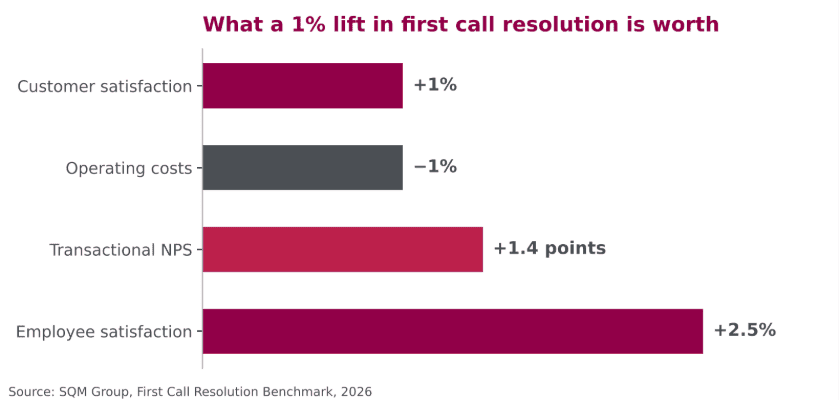
When agents cannot find an answer, they put customers on hold, transfer them, or give a partial answer. Each of these drives repeat contacts. SQM Group’s first call resolution benchmark research links every 1% improvement in first call resolution (FCR) to a 1% lift in customer satisfaction and a 1% cut in operating costs. The same research links each 1% FCR gain to a 1.4-point rise in transactional Net Promoter Score (NPS) and a 2.5% rise in employee satisfaction.
Turnover compounds the cost. The 2026 Australian Contact Centre Industry Best Practice Report puts frontline agent attrition at 25%, down from 29% in 2025. Every resignation takes knowledge out the door and restarts the training clock.
KnowledgeIQ Smart Search ranks results by relevance to each user’s group. It corrects spelling using a dictionary learned from your own content and finds the best match when a search term is imperfect. Knowledge managers can add synonyms and pin priority articles to the top of results. Agents reach the right answer in fewer clicks.
Old content creates conflicting answers. With automated version control in KnowledgeIQ, frontline staff see only the latest published version. Administrators can still compare earlier versions side by side and roll back when needed. Scheduled review dates and content expiry stop outdated articles from lingering.
Trust depends on governance. KnowledgeIQ supports custom approval workflows, role-based permissions and a full audit trail. Subject matter experts check content before it goes live, so agents can rely on what they read. Real-time alerts then tell targeted teams about policy changes and report on who has acknowledged them.
Complex procedures are hard to recall under pressure. KnowledgeIQ Process Flows turn lengthy process documents into a visual decision-tree format. Process Wizards guide staff step by step through highly regulated tasks and track usage for compliance. New agents build confidence sooner, and experienced agents can work across more business areas.
Agents are the first to spot missing or incorrect content. KnowledgeIQ lets users submit feedback directly against an article. Knowledge teams assign owners, priorities, and due dates, with colour-coding for overdue items. When agents see their feedback acted on, their trust in the system grows.
Every switch between screens adds clicks and pressure. KnowledgeIQ integrates with Salesforce, so agents access approved knowledge without leaving the Salesforce interface. An open API connects the same knowledge to other CX platforms and customer self-service channels. Customers and agents then receive the same answer, whatever the channel.
KnowledgeIQ customers have reported a 30% reduction in call transfers and average handling time, and a 50% reduction in staff onboarding and training time. Results vary by organisation, so set a baseline before you begin.
Two customer stories show the human impact:
Independent research supports these outcomes. Members of the Consortium for Service Innovation that adopt Knowledge-Centered Service (KCS) practices report a 70% improvement in time to proficiency and 20–35% better employee retention.
Contact centres are investing heavily in AI assistants and self-service. A Gartner survey of 321 customer service leaders found 91% face executive pressure to implement AI in 2026. The same survey found 58% plan to upskill agents into knowledge management specialists.
AI is only as reliable as the knowledge behind it. The 2026 Best Practice Report found that 82% of practitioners using a purpose-built KMS are satisfied or very satisfied, while not one user of SharePoint, Confluence or Salesforce knowledge tools was very satisfied. KnowledgeIQ acts as a governed system of record for AI. ANZ, for example, is integrating a new AI assistant into its KnowledgeIQ knowledge management portal.
Your agents want to resolve issues quickly and confidently. KnowledgeIQ, developed in Melbourne by Knosys and trusted by more than 40,000 users, gives them one trusted place to find the answer. If you would like to see how it works with your content and systems, book a short demo with our team.