In short: A contact centre needs a knowledge management system (KMS) when agents search several systems for one answer, customers receive inconsistent information, experts field constant questions, new hires take months to reach proficiency, or AI and self-service projects stall. Each sign carries a measurable cost to handling time, first-contact resolution, and customer satisfaction.
Most contact centres do not lack knowledge. They lack a reliable way to deliver it. Policies sit in shared drives; product updates arrive by email, and the answer to a tricky billing question lives in one team leader’s head. The result shows up in every metric a service leader reports on.
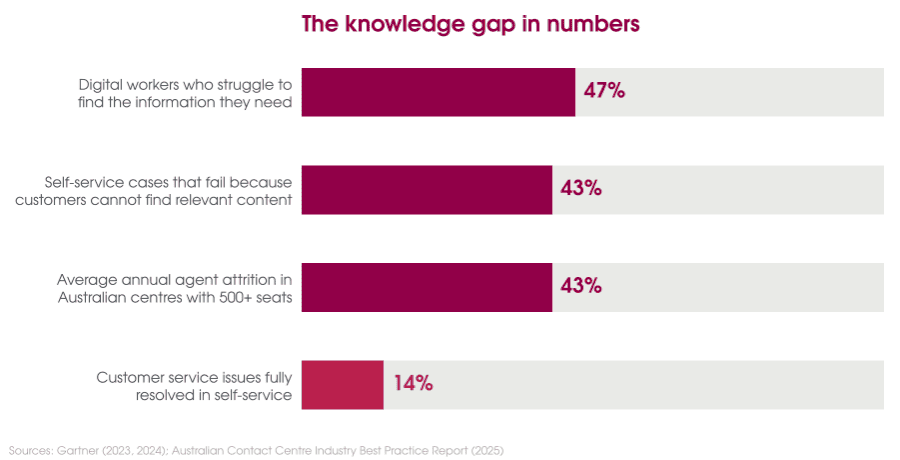
Gartner found that 47% of digital workers struggle to find the information they need to do their jobs effectively. In a contact centre, that struggle happens live, with a customer waiting on the line.
A knowledge management system is a central platform where an organisation creates, approves, publishes, and measures the information its people use. In a contact centre, it gives every agent the same current answer, on any channel, at the moment they need it. The five signs below show when existing tools no longer do that job.
When knowledge is spread across intranets, PDFs, FAQs and legacy wikis, agents switch between applications while the customer waits. Average handling time (AHT) climbs. Agents put customers on hold or transfer the call rather than risk a wrong answer.
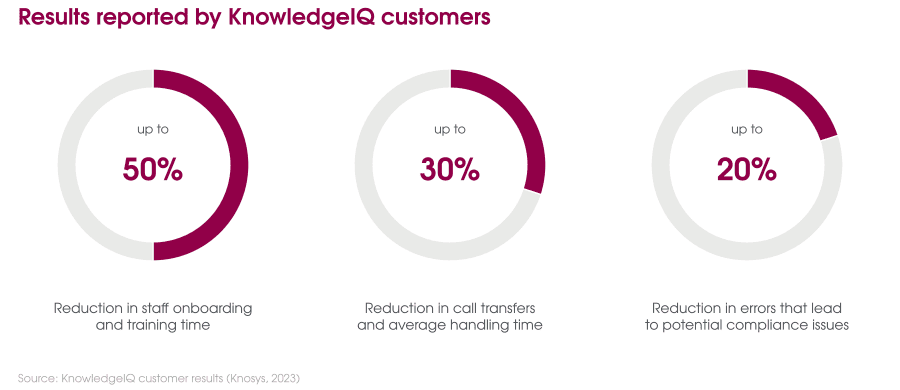
KnowledgeIQ Smart Search ranks results by relevance to each user’s group and corrects spelling using a dictionary learned from your own content. Administrators can pin critical articles to the top of the results. Integrations with your CX suite and an open API bring that knowledge into the tools agents already use. KnowledgeIQ customers report up to a 30% reduction in call transfers and average handling time.
Inconsistent answers erode customer trust quickly. The cause is usually duplicated or outdated content, where two versions of a policy exist, and nobody knows which one is current.
KnowledgeIQ creates a single source of truth with automated version control, custom approval workflows and scheduled review dates. Customer self-service draws on the same knowledge base as your agents, so the answer on your website matches the answer on the phone. When a policy changes, targeted alerts reach the right teams. Readership tracking then shows who has opened and acknowledged each update.
When agents queue at a team leader’s desk or flood a chat channel with questions, your expertise has become a bottleneck. Senior staff lose hours to interruptions, escalations rise and first-contact resolution (FCR) suffers.
KnowledgeIQ Process Wizards and decision trees turn expert know-how into step-by-step guidance that any agent can follow, including for complex or highly regulated tasks. The built-in feedback workflow lets agents flag missing or incorrect content against an article. Knowledge managers then fix the gap at the source, instead of experts answering the same question repeatedly.
Turnover is a permanent feature of contact centre life. The latest Australian Contact Centre Industry Best Practice Report put average attrition at around 43% for centres with 500 seats or more. The Australian Customer Experience Professionals Association puts the cost of replacing one agent at $21,561. Every departure takes knowledge out the door, and every new hire needs weeks of shadowing before they handle calls alone.
With knowledge structured in KnowledgeIQ, new agents learn from the same guided processes they will use on live calls. Knowledge quizzes confirm understanding and show team leaders where extra coaching will help. KnowledgeIQ customers report up to a 50% reduction in staff onboarding and training time. Read more about how knowledge management helps reduce agent turnover.
AI assistants, chatbots, and self-service portals are only as good as the knowledge behind them. Gartner reports that customers fully resolve only 14% of service issues through self-service. The most common point of failure is that customers cannot find content relevant to their issue.
The pressure to deploy AI keeps growing. In a late-2025 Gartner survey, 91% of customer service leaders said they face executive pressure to implement AI. The same research identified backlogs of knowledge articles and inconsistent content review as common obstacles.
KnowledgeIQ provides the governed, current knowledge base that AI and self-service depend on. Auto review and enforced content expiry keep articles accurate. Reporting and analytics show which content performs, where searches fail, and what new content your customers need.
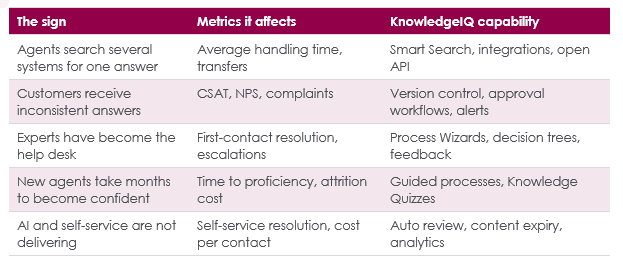
Each sign connects directly to a number on your contact centre dashboard. The table below shows where to look and which KnowledgeIQ capability addresses it.
Fixing these signs does not require more headcount. It requires knowledge that people trust and find quickly. Erik Dober, Senior Solicitor at the Office of Public Prosecutions Victoria, described the difference after moving to KnowledgeIQ:
“I am confident that if the answer is on the new platform, our solicitors can find it.”
For a contact centre leader, that confidence means shorter calls, fewer transfers, consistent answers, and new agents who reach proficiency sooner. You can read more KnowledgeIQ customer stories to see the results in practice.
If one or more of these signs feels familiar, a short conversation is a good first step. The KnowledgeIQ team will walk you through how other contact centres have addressed the same challenges, with no obligation to buy.
Book an obligation-free demo or contact the KnowledgeIQ team to start the conversation.